
The invisible language you speak every day
Think about how many icons you’ve tapped today. Dozens? Hundreds? From unlocking your phone this morning to closing your last app tonight, you’re constantly reading and responding to these tiny graphics. But here’s what’s wild—we barely notice them.
Icons are probably the most universal yet most overlooked part of our digital lives. We take them completely for granted. But they’re going through a massive transformation right now, and it’s way more interesting than you’d think. They’re evolving from flat symbols we read into something we can actually experience—with sight, sound, and even touch.
Let me walk you through the five biggest shifts happening in iconography right now.
1. The Floppy Disk that refuses to die
Let’s start with the most famous icon of all time: that little floppy disk that means “save.”
Here’s the problem—millions of people have never actually seen a floppy disk. They’re using a symbol for an object that’s been obsolete for decades. There’s this perfect example that went viral on Twitter: a Japanese Excel user thought the save icon was a “vending machine dispensing a canned drink.” I mean, if you squint, you can kind of see it?
This is the big risk with skeuomorphism—that whole design approach where digital stuff mimics real-world objects. When the object disappears from the real world, the symbol should become meaningless, right?
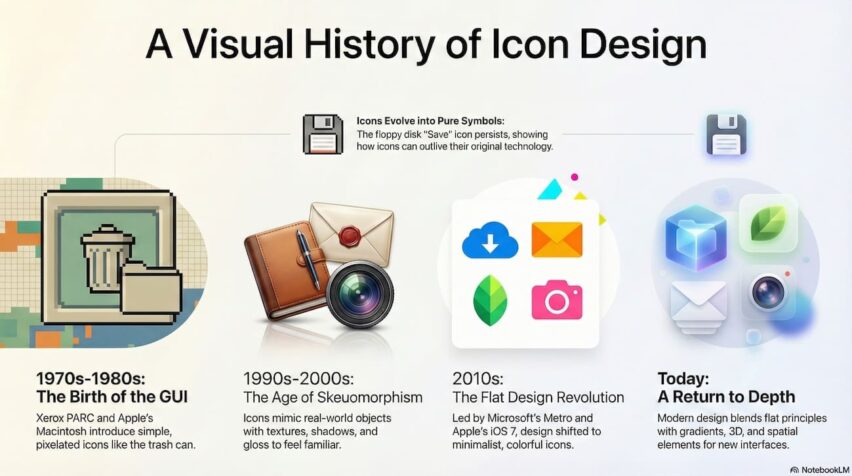
But here’s where it gets interesting. The floppy disk icon didn’t become meaningless. It transcended. It’s not representing a physical disk anymore—it’s representing the abstract concept of saving. It’s become technical shorthand that everyone recognizes, even Gen Z kids who’ve never touched a floppy disk in their lives.
So now designers face this dilemma: Do we keep using a symbol that technically makes no literal sense but works perfectly as convention? Or do we replace it with something more “accurate” and risk confusing millions of people who’ve internalized what that little square means?
I think the floppy disk won. It’s not going anywhere.
2. Icons learned to talk back
If icons are the words in our digital vocabulary, micro-interactions are the tone of voice.
For years, icons just sat there. They were static signposts. Tap here. Click this. Done.
That’s changed completely. Now icons are having full conversations with us through micro-interactions—those little animations and feedback moments that happen when you interact with something. A button changing color when you press it. That satisfying little bounce when you complete a task. These weren’t always standard. They used to be “nice to have” polish.
Now? They’re essential. They’re how interfaces actually communicate with us.
Without them, apps feel broken or unresponsive. It’s like talking to someone who never makes eye contact or nods. You can technically have the conversation, but something feels off. You can’t quite put your finger on it, but the interaction feels dead.
This matters because it makes digital experiences feel human. Icons aren’t just pointing anymore—they’re responding, confirming, guiding. They’re active participants in the interaction.
3. Realism is back (In the most futuristic way possible)
Icon design has had this interesting journey. Early on, we had skeuomorphism—realistic textures, shadows, the works. Susan Kare’s original Mac icons are still gorgeous examples of this.
Then in the 2010s, everything went flat. iOS 7 stripped away all the texture and depth. Clean lines, solid colors, super minimal. That was the aesthetic for years.
And now? Realism is coming back. But not where you’d expect.
Spatial computing—think Apple Vision Pro and mixed reality headsets—is bringing back depth, shadows, and 3D objects. These interfaces use “Gaze+Pinch” gestures and other new interaction models, and icons in these spaces need to feel like actual objects floating in a virtual environment. They have specular highlights, realistic shadows, reflections. They’re designed to look tangible.
So we’ve come full circle, but with way more sophistication. Turns out those real-world metaphors still work, even in our most futuristic interfaces. Maybe especially in our most futuristic interfaces, since everything else is so unfamiliar.
4. Icons became visual storytelling
There’s this layout trend that’s absolutely everywhere right now called the Bento Grid. It’s inspired by those Japanese lunch boxes where everything has its own little compartment. Apple uses it, Procreate uses it, everyone uses it.
What’s interesting is how this changed what icons actually do.
They’re not just controls anymore. In a Bento Grid, icons become part of the narrative. They’re visual chapters. You place them alongside text, images, and data to tell a compact story. Users can scan a grid and instantly understand complex features or navigate through content.
Icons in this context are almost like visual poetry. They need to communicate instantly and clearly, which is perfect for a layout designed to pack in a ton of information without overwhelming you.
It’s a small shift, but it fundamentally changes how we use icons—from utility to storytelling.
5. The future? Icons you can actually feel
Okay, this is where it gets really cool.
The next evolution of icons isn’t just visual. It’s tactile. Haptic technology is getting incredibly advanced—way beyond the basic vibration your phone does. We’re talking about technology that can make you feel a button press on a completely flat touchscreen.
The market for this is projected to hit $7.11 billion by 2034, and for good reason. Some of the applications are honestly mind-blowing.
There’s research into “mid-air haptics” that use ultrasonic waves to create sensations in the air. You could reach out and feel a button or texture without touching anything physical. Surgeons are already using haptic technology for remote robotic surgeries—they can feel realistic tissue resistance through the controls.
This is huge. Touch is the final sense we haven’t really engaged with digital interfaces. Once we cross that bridge, the gap between physical and digital basically disappears.
Imagine tapping an icon and actually feeling it click. Not just a vibration—an actual tactile response that mimics pressing a real button. That’s coming, and it’s going to completely change how we think about interface design.
What this all means
Icons aren’t simple pictures anymore. They’ve grown into this rich, multidimensional language.
They started as our Rosetta Stone for understanding computers—literal pictures of real things. They gained grammar through micro-interactions. They learned to tell stories in Bento Grids. Now they’re becoming 3D objects in spatial computing and developing a sense of touch through haptics.
These tiny symbols are the foundation of how we interact with technology, and they’re constantly evolving to become more intuitive and more human.
Which leaves me wondering: as digital and physical reality keep merging, what new icons will we need to invent? And more importantly, what will those symbols say about who we’re becoming?