
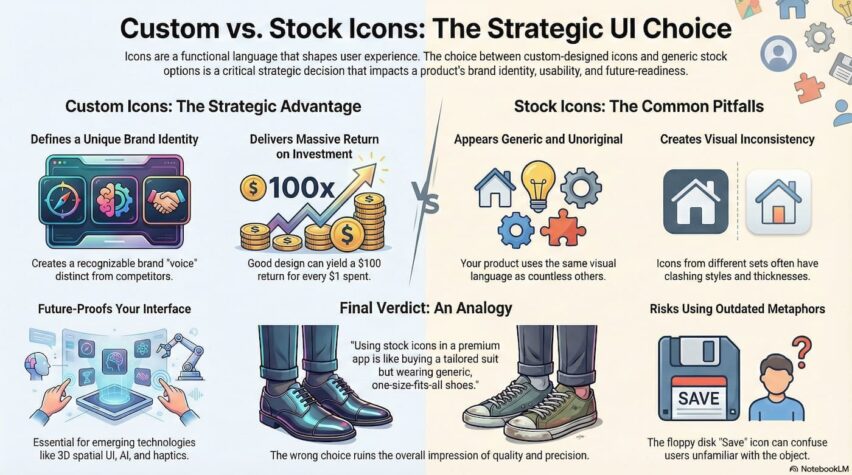
Look, I get it. When you’re deep in a project and need icons fast, it’s tempting to grab a pack from a stock library and call it done. I’ve been there. But here’s the thing designers don’t talk about enough: icons aren’t just decoration. They’re how your users actually navigate and understand your product.
As interfaces get smarter and more context-aware, this decision matters more than ever. Custom icons versus stock isn’t just a budget question—it’s a fundamental choice about how clearly your product communicates and how memorable your brand becomes.
Why custom icons actually matter
Here’s what changed my thinking: icons are functional shortcuts. They let users interact with your product faster than reading text. Stock icons are convenient, sure. But they rarely nail the specific functional and emotional needs of a well-designed product.
Let me break down why custom iconography is worth the investment.
1. Your brand needs a visual voice
Stock icons are generic by definition. They’re designed to work for everyone, which means they work perfectly for no one.
Think about it—if you and three competitors are all using the same icon set, how does your product stand out? 75% of professionals say good design is critical to company success. Using the same visual language as everyone else undermines that before users even interact with your features.
Custom icons become part of your brand’s personality. They’re as distinctive as your logo or color palette. They make your product instantly recognizable.
2. Consistency is harder than it looks
One of the biggest problems I see with stock icon implementations? Inconsistency.
You’ll have one icon with thin strokes, another with thick fills, a third with way more detail than the others. It looks amateurish, and it makes the interface harder to scan. Users might not consciously notice, but their brain is working overtime to make sense of the visual chaos.
Custom icon systems solve this. Everything follows the same rules—stroke weight, corner radius, level of detail, style. Whether users are on mobile, desktop, or even newer spatial interfaces, the visual language stays coherent.
3. Not All Metaphors Age Well
Stock libraries are full of outdated visual metaphors that don’t resonate with everyone.
The floppy disk save icon is the classic example. It’s become so universal that it works as pure convention now—but there’s that famous story about a younger user mistaking it for a “vending machine dispensing a drink.”
When you design custom icons, you can adapt metaphors for your specific audience. You can make sure they’re culturally relevant and actually clear for the people using your product, not just technically correct according to some decades-old standard.
The honest comparison
Let me lay out the real trade-offs:
Custom Icons:
- Pros: Unique to your brand, optimized for your specific functions, visually consistent, better long-term ROI (some studies show $100 return for every $1 invested in good design)
- Cons: Higher upfront cost, takes more time, requires professional expertise
Stock Icons:
- Pros: Cheap or free, instantly available, familiar for super basic functions (like a house icon for “home”)
- Cons: Generic and forgettable, often inconsistent when mixed together, risk of confusing metaphors or ambiguous meanings
For quick prototypes or internal tools? Stock can work. For anything customer-facing or enterprise-level? Custom is usually the better call.
Where icons are heading in 2026
This is where it gets interesting. The technical demands on icons are increasing fast, which makes custom design even more valuable.
Spatial and 3D interfaces are becoming real. With devices like the Vision Pro, icons aren’t flat graphics anymore—they need depth, realistic lighting, shadows. Stock 2D icons don’t translate well into these environments.
Generative UI is another big shift. Interfaces that rebuild themselves in real-time based on what you’re trying to do need flexible icon components. Custom systems integrate into these AI-driven interfaces way more smoothly than rigid stock files.
Haptic feedback is adding a whole new dimension. Users will soon be able to feel icons when they interact with them. The haptic technology market is exploding—projected to hit $7.11 billion by 2034. Research shows haptic feedback can reduce stress by 74% in just 30 seconds. That’s a level of engagement that goes way beyond visuals.
Sustainable design matters too. Custom, lightweight vector icons are more energy-efficient than bloated stock imagery. They require less processing power and smaller data transfers, which adds up when you’re serving millions of users.
The bottom line
Stock icons have their place—prototypes, MVPs, internal dashboards. But for anything serious, custom iconography is a strategic investment, not a luxury.
Custom icons ensure accessibility by avoiding unnecessary complexity. They support users with cognitive differences like dyslexia. They build trust by respecting your users’ intelligence with clear, purposeful communication.
Most importantly, they give your product a visual voice that’s uniquely yours. In a world where every app is competing for attention, that distinctiveness matters more than ever.
Looking for a platform to design you custom icon sets for your projects? Contact us now!
Thank you NotebookLM for the cover image 🙂