
I’ve been in this industry long enough to see trends come and go. I’m working with an eCommerce and web design agency since 2003 and founded Iconiza in 2007.
Every January, we get bombarded with predictions about the “next big thing” in design. Most of it? Noise. But right now, there are some genuinely fundamental shifts happening that go way beyond new color palettes or the latest design system.
These aren’t your typical trend predictions. Some of them might even surprise you.
1. AI isn’t your assistant anymore—It’s your co-designer
Remember when we used AI to generate lorem ipsum or maybe suggest a few layout options? Those days feel quaint now.
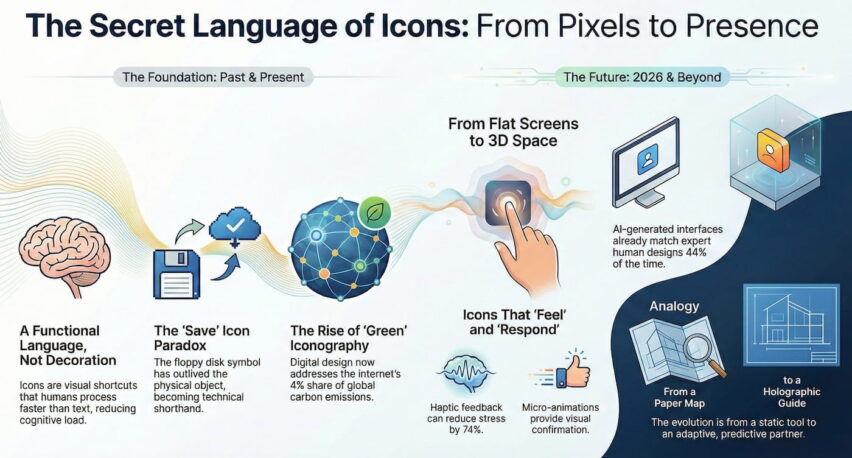
Here’s what’s actually happening: we’re moving from designing static screens to designing the rules that let AI generate interfaces on the fly. This is the world of Generative UI and Agentic UX, and it’s not some distant future thing. Business leaders are already putting their money where their mouth is—88% are increasing AI budgets specifically for these capabilities.
Think about it. Instead of crafting one perfect user journey that everyone follows, interfaces will adapt in real-time based on who you are, what you’re trying to do, and how much you already know. Your dashboard and mine might look completely different, because they’re being generated for our specific contexts.
As designers, this changes everything. We’re no longer pixel-pushers. We’re becoming orchestrators of what I call “human-agent ecosystems.” You’ll oversee master agents that route tasks to specialized AIs, manage the handoffs between them, and decide when humans need to step in. It’s a completely different design challenge.
One thing that keeps me up at night: making sure these systems feel trustworthy and coherent. Nobody wants to feel like they’re juggling a dozen different chatbots. The experience needs to feel like working with one intelligent partner.
Welcome to the death of static design.
2. The screen is losing its monopoly
For my entire career, I’ve designed for rectangles. Phones, tablets, laptops—all flat glass. That era is ending.
The interface is breaking out into the physical world, and it’s becoming genuinely multimodal. Voice, gesture, touch, even spatial awareness—users will flow between these input methods without thinking about it.
Voice is the big one people underestimate. Over 157 million Americans will be using voice assistants regularly. That means conversational design isn’t a nice-to-have anymore. It’s core.
Then there’s spatial computing. Mixed reality hardware is finally becoming accessible, and we’re figuring out new interaction patterns like “Gaze+Pinch” for navigation. Suddenly, we’re not designing 2D surfaces—we’re designing 3D environments.
And haptics? That’s adding a whole other layer. The market for realistic tactile feedback is exploding, expected to hit $7.11 billion by 2034. People want to feel digital interactions, especially in gaming and healthcare.
The future of UX is conversational, spatial, and tactile. Our interfaces will float in the air, respond to our voices, and give us physical feedback. Wild times.
3. That floppy disk icon is never going away (And that’s fine)
Here’s something weird: as technology races forward, we’re still using symbols from decades ago.
Take the floppy disk save icon. Actual floppy disks disappeared years ago. There are adults now who’ve never held one. Someone once mistook the icon for a “vending machine,” which would be hilarious if it wasn’t a real UX problem.
You’d think we’d replace it with something modern, right? Maybe a cloud symbol or something abstract?
But here’s the thing—we tried. And it turns out, that floppy disk has become so universal that it’s transcended its original meaning. It’s not representing a physical object anymore. It’s representing the concept of saving. It’s become part of our shared digital language.
This is skeuomorphism taken to its logical extreme. The symbol outlived the object and became pure convention. And once something becomes that embedded in our collective understanding, changing it actually makes things harder, not easier.
There’s a lesson here about the power of established meaning versus literal representation.
4. Your website has a carbon footprint (And it’s bigger than you think)
I’ll be honest—I didn’t think much about this until recently. But every image we optimize, every script we load, every server request we make? It all consumes energy.
The internet produces nearly 4% of global carbon emissions. That’s on par with the aviation industry. Let that sink in.
This has given birth to sustainable web design, and it’s not about making ugly, stripped-down sites. It’s about being intentional:
- Using efficient image formats like WebP and lazy-loading content that’s not immediately needed
- Writing cleaner code and cutting out bloated libraries that aren’t pulling their weight
- Choosing hosting providers that run on renewable energy
The W3C is already developing official Web Sustainability Guidelines. This is becoming standardized, which means it’s moving from “nice to do” to “required for credibility.”
Green design isn’t virtue signaling anymore. It’s smart business and basic professional responsibility.
5. Accessibility is a growth strategy, not a checkbox
Let’s talk about something that frustrates me: accessibility being treated as a compliance exercise.
Here’s the reality: 71% of users with disabilities will leave your site if it’s not accessible. That’s not a small market segment. That’s a massive chunk of potential users you’re actively turning away.
And the legal landscape is tightening. The European Accessibility Act is making non-compliance genuinely risky. But forget avoiding lawsuits for a second—accessible design actually drives ROI and creates competitive advantage.
Here’s what really gets me excited: when you design for cognitive diversity—clear visual hierarchy, plain language, predictable navigation—you end up creating better experiences for everyone. An accessible interface is just a well-designed interface.
This stopped being an option. It’s now table stakes.
6. Minimalism got structure: Meet the Bento Grid
Minimalism has been huge for years, but it’s evolved. Enter the Bento Grid—a layout trend that’s absolutely everywhere right now.
Think of a Japanese bento box: everything has its place, it’s visually organized, but there’s variety and interest. That’s exactly what this grid does for digital content. You get images, text, data viz, and media all organized into a clean, asymmetrical grid.
Apple really popularized this with their product pages, making tech specs actually interesting to look at. Microsoft’s Metro design language laid a lot of the groundwork too.
What makes it effective? It’s fantastic for storytelling. You can guide users through content in a specific sequence, creating a narrative flow. It handles complex information—dashboards, feature-heavy homepages—without becoming overwhelming.
This proves that minimalism isn’t about having less. It’s about presenting complexity with clarity and structure.
Where does this leave us?
Design in 2026 is smarter, more responsible, and more genuinely human-centered than it’s ever been. We’re moving beyond screens, partnering with AI, and taking real responsibility for our impact on users and the planet.
The winning products won’t be the ones with the most features. They’ll be the ones that respect users’ time, intelligence, privacy, and the world we share.
Which brings me to a question I keep coming back to: As interfaces become more predictive and blend into our environment, what’s left for human designers to do?
I don’t have the answer yet. But I’m excited to find out.
BTW, the main image in this post was done with NotebookLM.